Need Service Today? Contact Us Now!

As a homeowner in Rocklin, you are well acquainted with the dramatic temperature shifts that characterize the Placer County climate. Our geographic position in the Sacramento Valley brings crisp, freezing winter nights that require a robust heating system, followed by blistering summer afternoons where temperatures routinely cross the triple-digit mark. Your heating, ventilation, and air conditioning equipment acts as the literal heart of your home infrastructure, working continuously to maintain safe, comfortable indoor environments.
Because our climate forces HVAC systems to handle intense thermal loads, relying on a reactive approach to system maintenance is an expensive gamble. Waiting for your air conditioner to stop blowing cold air during a chaotic July heatwave can lead to high-stress situations, extended wait times for parts, and emergency surcharges. The single most effective way to protect your financial investment and guarantee year-round comfort is by scheduling a professional, comprehensive system evaluation before severe seasonal weather arrives. At Rocklin Heating & Air, we believe that transparency builds trust. This guide walks you through exactly what happens during a professional mechanical evaluation, detailing the specialized technical checks that keep your home safe and energy efficient.
The Difference Between a Basic Check-Up and a Deep Evaluation
Many homeowners confuse a professional HVAC evaluation with a standard visual tune-up or a simple air filter replacement. While keeping your filters clean is a necessary monthly task, a professional technical evaluation is a highly diagnostic, scientific audit of your entire climate control network.
An HVAC system operates at the complex intersection of high-voltage electrical circuitry, complex refrigeration physics, internal combustion thermodynamics, and fluid dynamics. If a single component drifts outside of its precise manufacturer specifications, it creates a domino effect that overstresses the surrounding mechanisms. During an evaluation, a certified technician from Rocklin Heating & Air utilizes advanced digital testing equipment to look beneath the surface, identifying hidden micro-failures and calibration issues long before they result in a total system collapse.
Step One: The Electrical Grid Audit
Every modern heating and cooling system relies on a steady, safe supply of electrical current to power its motors and compressor pumps. The evaluation process always begins with a comprehensive safety scan of your equipment’s electrical infrastructure.
Testing Capacitors and Contacts
The technician opens the outdoor electrical disconnect cabinet and the main system access panels to inspect the electrical contactors and capacitors.
-
Measuring Microfarads: Start and run capacitors act like temporary batteries, storing up a massive electrical reserve to push the fan motors into motion. Over time, high summer temperatures cause these components to degrade or bulge. We measure their storage capacity precisely. If a capacitor is failing, it will burn out your expensive fan motor next.
-
Inspecting Contactors: The contactor is the switch that closes to send high-voltage power to your compressor. We check these points for pitting, arcing, or insect infestations common to the Rocklin area, which can cause the switch to weld shut or fail to engage.
Verifying Amperage and Voltage Drops
The technician utilizes a digital clamp meter to measure the exact electrical amperage drawn by your compressor pump and indoor blower motor during an active cycle. If a motor is pulling more current than its factory nameplate allows, it indicates extreme internal mechanical friction, a failing winding, or a dangerous voltage restriction within your electrical panel.
Step Two: The Refrigeration Cycle Scan
For your system to cool your home efficiently during a hot valley afternoon, the thermodynamic closed-loop refrigeration cycle must perform flawlessly.
Digital Gauge Manifold Analysis
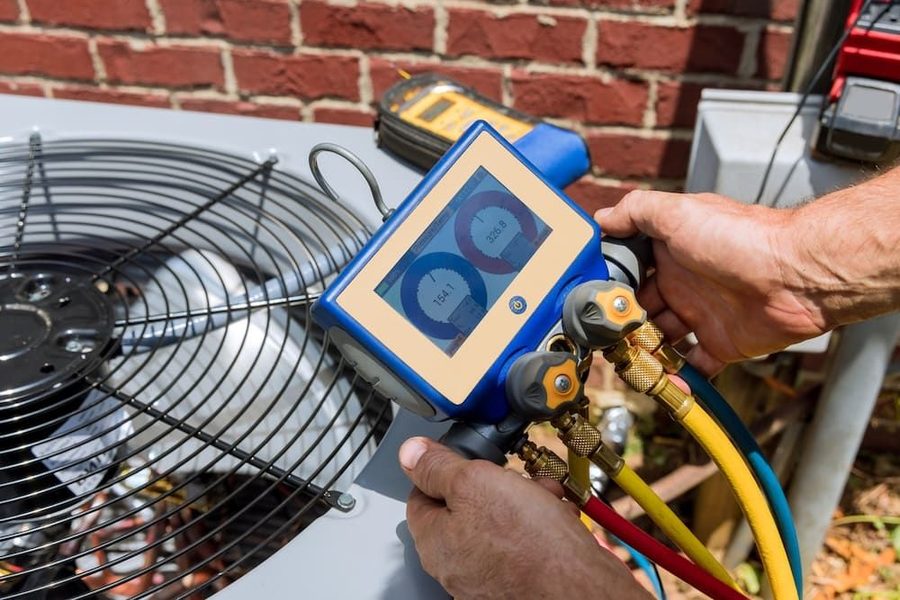
Our technicians connect high-tech digital manifold gauges to the outdoor suction and liquid line service valves. This allows us to monitor the operating pressures of your refrigerant in real time.
-
The Balance of Pressures: Having the correct volume of refrigerant is critical. If your system is low on refrigerant, it means you have a physical leak somewhere in your lines, which will cause your indoor evaporator coil to freeze into a solid block of ice.
-
Measuring Subcooling and Superheat: We do not simply look at pressure numbers. We measure subcooling and superheat metrics against the outdoor ambient temperature and indoor wet-bulb metrics, ensuring the expansion valve is metering liquid refrigerant with absolute mathematical precision.
Inspecting Heat Transfer Coils
The technician conducts a thorough physical assessment of both the outdoor condenser coil and the indoor evaporator coil. If the delicate aluminum fins are caked with spring pollen, dust, or grass clippings, the system cannot shed heat efficiently, forcing the compressor to run twice as long to achieve the same cooling results.
Step Three: Airflow Mechanics and Ductwork Evaluation
An air conditioner or furnace can only cool or heat your living space if it can successfully move air uniformly through your entire property layout.
Monitoring Static Pressure
The technician performs a static pressure test, which is essentially taking the blood pressure of your home ventilation network. By drilling small test holes before and after the air handler and inserting specialized pressure probes, we can see how much resistance your duct network is exerting against the blower fan. High static pressure is a silent killer, caused by crushed flexible ducts, poor trunk design, or utilizing overly restrictive air filters.
Condensate Drainage Network Treatment
Because an AC pulls gallons of water out of the humid valley air daily, the drainage infrastructure must remain clear.
We check the primary condensate pan for rust or cracks and flush the entire length of the PVC plastic drain line. Clearing out any winter accumulation of algae or sludge prevents a sudden summer blockage from overflowing your pan and causing catastrophic water damage to your home’s ceilings and drywall.
Step Four: Gas Furnaces and Fuel Safety Checks
If your system includes a conventional gas or propane furnace, ensuring the integrity of the combustion process is our absolute highest safety priority.
-
Cracked Heat Exchanger Scans: The heat exchanger is the metal chamber where gas burns to create warmth. If this metal cracks due to age or overheating, lethal carbon monoxide gas can leak directly into your indoor air streams. We utilize specialized flexible fiber-optic cameras to inspect every internal weld and curve of the exchanger walls for structural integrity.
-
Gas Valve and Flame Sensor Alignment: We measure incoming gas pressure metrics to prevent over-firing, clean the tiny flame sensor rod to prevent short-cycling shutdowns, and verify that all safety limit switches trip correctly if an airflow failure occurs.
Secure Your Home’s Comfort
A comprehensive professional HVAC system evaluation is the single most valuable step you can take to protect your family’s safety, lower your monthly utility statements, and ensure your home remains a cool sanctuary regardless of how high the summer temperatures climb. By identifying and correcting minor mechanical vulnerabilities early, you can step into the upcoming season with absolute confidence.
Do not wait for a complete system breakdown during a dangerous heatwave to evaluate your equipment health. Contact Rocklin Heating & Air today to schedule your professional system evaluation with our expert technical team. Let our family-operated business deliver the reliable, honest comfort solutions that give your Placer County household total peace of mind all year long.